
Comprehensive IP Prosecution, Litigation & Commercialization
AnA Law Firm provides end-to-end Intellectual Property services with a corporate-centric approach. Our attorneys, spanning technology and legal domains, deliver a rare synergy of legal opinion and out-of-the-box thinking to protect ideas and IP assets, and to unlock their commercial value.
Whether you are safeguarding a brand, protecting an invention or enforcing your rights, we manage the full lifecycle of your intellectual property, from search and filing to prosecution, litigation, licensing and valuation.
Protect Your IP
Tell us about your requirement and our attorneys will respond promptly.

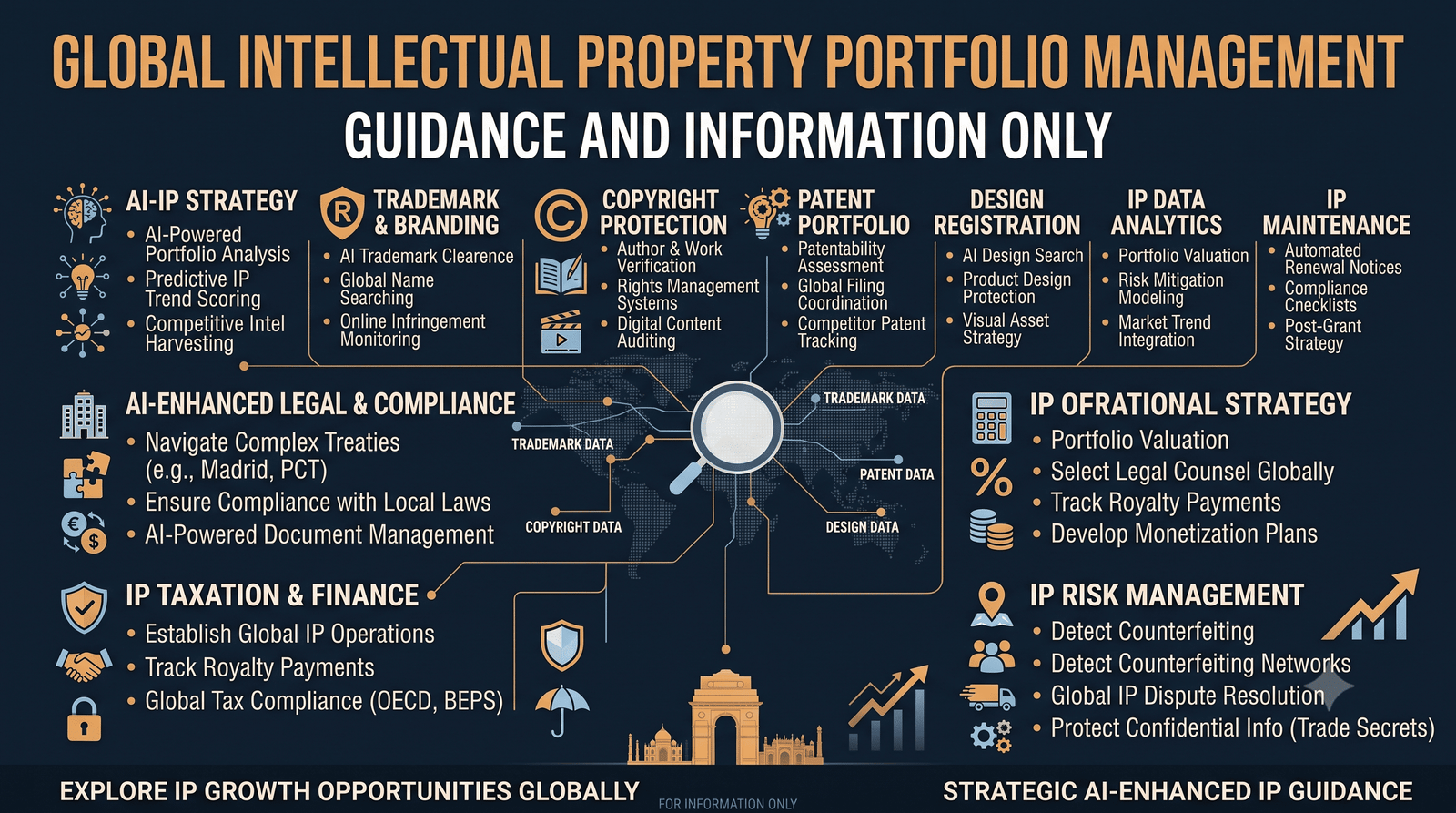

Our IPR Services
Trademarks & Service Marks
Trade name searches, registration of trademarks and service marks, drafting and filing replies to objections, and representing clients at hearings before the Trademark Registry.
Patents
Patentability searches, drafting, filing and prosecution across technology domains, handled by attorneys with deep technical competence.
Copyright
Registration and enforcement of copyright for literary, artistic, musical, software and other original works.
Industrial Designs
Protection and registration of the aesthetic and ornamental aspects of your products and packaging.
International Trademark Searches
Worldwide trademark availability opinions coordinated for clients seeking to adopt new marks across jurisdictions.
IP Litigation & Enforcement
Representation in all types of trademark disputes including domain names, infringement and passing-off litigation.
Licensing & Assignment
Drafting agreements for licensing, assignment, sale & purchase, technology transfer and IP valuation.
Portfolio Management
Advising businesses on maximizing existing trademark portfolios and selecting new marks, including trade dress.
Copyright, Design, Patent & Trademark
Copyright, design, patent, and trademark are all different types of intellectual property (IP). Although these types of IP are very different, people often confuse them. A brief description of each, including how these forms of IP differ, is provided below.
What’s Copyright?
Copyright (or author's right) is the exclusive legal right given to the creators over their literary and artistic works. The creative work may be in a literary such as books, artistic such as music, paintings, sculpture, and films, to computer programs, databases, advertisements, maps, and technical drawings.
How to get a copyright registered in India?
Documents required for filing of a copyright application:
- Four copies of the artistic work.
- Name address and nationality of the applicant
- Nature of the applicant's interest in the work
- Title of the work
- Name, address and nationality of the author and if the author is deceased the date of his death
- Year and country of first publication and name and address and nationality of the publisher.
- Year and countries of subsequent publications, if any, and names, address and nationalities of the publishers.
- Names, addresses and nationalities of the owners of the various rights comprising the copyright in the work and the extent of right held by each other, together with particulars of assignments and licenses, If any.
- Names, addresses and nationalities of other person, if any, authorized to assign or license the rights comprising the copyright.
- No objection certificate from the trademarks registry.
- Power of attorney on Indian Stamp paper.
What’s Design?
A Design is a form of intellectual property that protects the visual appearance or aesthetic features of an article. In India, the protection of industrial designs is governed by the Designs Act, 2000, which grants exclusive rights over new and original designs applied to articles through an industrial process. Design protection is intended to safeguard the ornamental and non-functional aspects of a product, enabling the proprietor to prevent unauthorized reproduction, imitation, or commercial use of the registered design.
What a Design includes:
- Shape - The external form or contour of an article.
- Configuration - The arrangement or structural appearance of the various parts of an article.
- Pattern - Decorative or repetitive designs applied to the surface of an article.
- Ornament - Embellishments or decorative features that enhance the visual appeal of an article.
- Composition of Lines - Distinctive arrangements or combinations of lines contributing to the overall appearance.
- Composition of Colours - Unique combinations or arrangements of colours applied to an article.
- Two-Dimensional (2D) Features - Surface features such as patterns, lines, or colours applied to an article.
- Three-Dimensional (3D) Features - Features relating to the shape, configuration, or ornamentation of an article.
- Visual Appearance - Features that are judged solely by the eye and contribute to the aesthetic appeal of the finished article.
- New and Original Features - Designs that are novel, distinctive, and capable of registration under the provisions of the Designs Act, 2000.
Design protection does not extend to functional or mechanical aspects of an article, methods or principles of construction, trade marks, property marks, artistic works protected under copyright law, or any feature dictated solely by technical necessity. Registration of a design confers upon the registered proprietor the exclusive right to apply the design to the article in the relevant class for a period of ten years, which may be extended by a further five years in accordance with the provisions of the Designs Act, 2000.
What’s Patent?
The primary goal of patent law is to encourage innovation and commercialization of technological advances. Patent law incentivizes inventors to publicly disclose their inventions in exchange for certain exclusive rights. A patent protects inventions, which can include new and useful processes, machines, manufactures, compositions of matter as well as improvements to these. Certain computer programs may fall within the subject matter protected by both patents and copyrights. In this respect the patent system complements copyright protection by providing protection for functional aspects of software, which are not protected by copyright.
Unlike copyright protection, to get patent protection one must first apply for and be granted a patent from the patent office. Unlike the copyright registration process, the patent application process is expensive, complex, difficult, and time consuming and generally should not be attempted without the assistance of an experienced patent attorney or agent.
What’s Trademark?
A trademark is a type of intellectual property consisting of a recognizable sign, design, or expression which identifies products or services of a particular source from those of others, although trademarks used to identify services are usually called service marks. We have seen increased IPR awareness in the recent past. The trademark owner can be an individual, business organization, or any legal entity. Therefore, entities and individuals are in quest to protect their mark from being copied. Trademarks in India are listed by the Controller General of Patents Designs and Trademarks, Ministry of Commerce and Industry, Government of India.
Once a trademark registration process is done, the R symbol can be applied and the registration will become valid for 10 years. Registered trademarks nearing expiry can regularly renew the registration process by filing a trademark renewal application for a time of another 10 years.
We offer a quality of trademark services like trademark filing, trademark search, trademark renewal, Copyright and patent registration, etc.
| Copyright | Design | Patents | Trademark | |
|---|---|---|---|---|
| What’s Protected? | Original works of authorship, such as books, articles, songs, photographs, sculptures, choreography, sound recordings, motion pictures, and other works | Visual appearance, aesthetic features of articles - shape, configuration, pattern, ornament, composition of lines or colours | Inventions, such as processes, machines, manufactures, compositions of matter as well as improvements to these | Any word, phrase, symbol, and/or design that identifies and distinguishes the source of the goods of one party from those of others |
| Requirements to be Protected | A work must be original, creative and fixed in a tangible medium | Must be new or original, not previously published, and appeal solely to the eye | An invention must be new, useful and nonobvious | A mark must be distinctive (i.e., it must be capable of identifying the source of a particular good) |
| Term of Protection | Author’s life plus 70 more years | 10 years from the date of registration, extendable for another 5 years | 20 years | For as long as the mark is used in commerce. Initially 10 years |
| Rights Granted | Right to control the reproduction, making of derivative works, distribution and public performance and display of the copyrighted works | Exclusive right to apply the design to articles and prevent others from copying the aesthetic features | Right to prevent others from making, selling, using or importing the patented invention | Right to use the mark and to prevent others from using similar marks in a way that would cause a likelihood-of-confusion about the origin of the goods or services |
| Do I need to renew my registration periodically? | No | Can be extended once for 5 years after the initial 10-year term | For the patent to remain in force for the full 20-year period, maintenance fees are due after 3.5, 7.5, and 11.5 years | Every 10 years |
Secure Your Intellectual Property Today
Speak to our IP attorneys about protecting, enforcing and commercializing your ideas.
Consult an IP Attorney